Tomorrow, a bill will come to the House of Commons that would extend Marriage Equality to Northern Ireland. The Labour MP Conor McGinn has proposed the Marriage (Same Sex Couples) (Northern Ireland) Bill. The co-sponsors of the bill are Conservative MP Nick Herbert, Liberal Democrat MP Layla Moran and the Green Party’s Co-Leader Dr Caroline Lucas.
The legislation would allow same-sex couples in Northern Ireland to get married and would bring the law in line with England, Wales and Scotland. Delivering same-sex marriage in England and Wales was one of the achievements Conservative-led coalition government in 2014.
The Bill received cross-party support from local parties, in the province where the legislative assembly had previously voted in favour of it, but blocked under the rules by the Democratic Unionist Party (DUP), but the collapse of the Northern Ireland Assembly means it has fallen to the Westminster Parliament to address the issue.
Commenting on the Bill, Layla Moran said: "Delivering same-sex marriage in England is one of the proudest achievements of the Liberal Democrats’ time in coalition government - but sadly many couples in Northern Ireland are not allowed to marry the person they love.
Ms Moran continued: "I’d much rather that this decision was taken by local politicians in Belfast, but given that it doesn’t seem the Assembly will be up and running again soon, I believe that Westminster MPs are right to change the law to provide marriage equality for everyone.
"It is a real honour and a privilege to be sponsoring this legislation. I hope that all parties will now support it and make sure it becomes law as quickly as possible so that everyone, in all parts of the United Kingdom, no matter where they live or who they love, can get married." Layla Moran added.
Northern Ireland Secretary of State Karen Bradley said the Government, as with the 2014 Same Sex Marriage Act, would allow Conservative MPs to have a free vote on the Bill due to it being a matter of conscience. Its unknown if the Official Opposition Labour party will also give their MPs a free vote.
Showing posts with label Labour. Show all posts
Showing posts with label Labour. Show all posts
Tuesday, 27 March 2018
Tuesday, 16 May 2017
Corbyn launches Labour manifesto in Bradford
Leader of the Labour Leader, Jeremy Corbyn, speaking at the launch of The Labour Party Manifesto 2017 in Bradford, said:
"It’s a pleasure to be in Bradford today to launch Labour’s manifesto, “For the many not the few”. I’m pleased to be here in Bradford University where that great Labour Prime Minister Harold Wilson was the first Chancellor. Harold Wilson had a vision for Britain and created the institutions to match, like the Open University.
Today we set out vision to transform Britain for the 21st century. This manifesto is the first draft of a better future for the people of our country. A blueprint of what Britain could be and a pledge of the difference a Labour government can make.
Like thousands of other Labour party members, I’ve been making that case to people across the country over the last few weeks. As this campaign has continued, for an election called by a Prime Minister with scant regard for her own solemn pledges, opinion has started to move towards Labour.
There is no great secret as to the reason. People want a country run for the many not the few. That is because for the last seven years our people have lived through the opposite; a Britain run for the rich, the elite and the vested interest They have benefitted from tax cuts and bumper salaries while millions have struggled.
Whatever your age or situation, people are under pressure, struggling to make ends meet. Our manifesto is for you. Parents worrying about the prospects for their children and anxious about the growing needs of their own elderly parents. Young people struggling to find a secure job and despairing of ever getting a home of their own. Children growing up in poverty. Students leaving college burdened with debt. Workers who have gone years without a real pay rise coping with stretched family budgets. Labour’s mission, over the next five years, is to change all that.
Our manifesto spells out how. With a programme that is radical and responsible. A programme that will reverse our national priorities to put the interests of the many first. Will change our country while managing within our means. And will lead us through Brexit while putting the preservation of jobs first.
For seven years the Conservatives have been holding Britain back. Low investment, low wages, low growth. Labour will move Britain forward with ambitious plans to unlock the country’s potential. Labour will set up a National Investment Bank and regional development banks to finance growth and good jobs in all parts of the UK through major capital projects. Labour will invest in our young people through a National Education Service focussed on childcare, schools and skills, giving them the capacity to make a productive contribution to tomorrow’s economy.
Labour will take our railways back into public ownership, to put the passenger first. We will take back control of our country’s water by bringing it into regional public ownership. And we will take a public stake in the energy sector to help keep fuel prices down and ensure a balanced and green energy policy for the future. The Tories now want to scare us into accepting more of the same. Only Labour has a plan ambitious enough to unleash the country’s potential. And only Labour has a plan to make Brexit work for ordinary people. We are clear: The choice is now a Labour Brexit that puts jobs first, or a Tory Brexit that will be geared to the interests of the City, and will risk making Britain a low-wage tax haven.
As we leave the European Union, because that is what the people have voted for, only Labour will negotiate a deal that preserves jobs and access to the single market, preserves rights and does not plunge our country into a race to the bottom. All this is costed, as the documents accompanying our manifesto make clear. Our revenue-raising plans ensure we can embark on this ambitious programme without jeopardising our national finances.
We are asking the better-off and the big corporations to pay a little bit more – and, of course, to stop dodging their tax obligations in the first place. And in the longer term we look to a faster rate of growth, driven by increased private and public investment, to keep our accounts in shape. This is a programme of hope.
The Tory campaign, by contrast, is built on one word: Fear What would another 5 years of Conservative government mean for Britain? Just look back at the last seven: More children in poverty. Fewer young couples able to buy their first home. More people queuing at food banks. Fewer police on the beat … fewer firefighters too. More people are in work but they’re not getting the pay or the hours to make ends meet. More young people are in debt. Will the Tories change their spots? Don’t bank on it. Their record says they wont.
Theresa May will disagree of course. So I say to her today: Prime Minister, come out of hiding and let’s have that debate on television so millions can make up their minds. What are you afraid of? It’s not too late Let’s debate our two manifestos Have the argument I am confident that once the British people get the chance to study the issues Look at the promises They will decide that Britain has been held back by the Tories. That the few have prevailed over the many for too long. And that they will decide it is now time for Labour.
Our country will only work for the many not the few if opportunity is in the hands of the many. So our manifesto is a plan for everyone to have a fair chance to get on in life, because our country will only succeed when everyone succeeds.
Thank you."
"It’s a pleasure to be in Bradford today to launch Labour’s manifesto, “For the many not the few”. I’m pleased to be here in Bradford University where that great Labour Prime Minister Harold Wilson was the first Chancellor. Harold Wilson had a vision for Britain and created the institutions to match, like the Open University.
Today we set out vision to transform Britain for the 21st century. This manifesto is the first draft of a better future for the people of our country. A blueprint of what Britain could be and a pledge of the difference a Labour government can make.
Like thousands of other Labour party members, I’ve been making that case to people across the country over the last few weeks. As this campaign has continued, for an election called by a Prime Minister with scant regard for her own solemn pledges, opinion has started to move towards Labour.
There is no great secret as to the reason. People want a country run for the many not the few. That is because for the last seven years our people have lived through the opposite; a Britain run for the rich, the elite and the vested interest They have benefitted from tax cuts and bumper salaries while millions have struggled.
Whatever your age or situation, people are under pressure, struggling to make ends meet. Our manifesto is for you. Parents worrying about the prospects for their children and anxious about the growing needs of their own elderly parents. Young people struggling to find a secure job and despairing of ever getting a home of their own. Children growing up in poverty. Students leaving college burdened with debt. Workers who have gone years without a real pay rise coping with stretched family budgets. Labour’s mission, over the next five years, is to change all that.
Our manifesto spells out how. With a programme that is radical and responsible. A programme that will reverse our national priorities to put the interests of the many first. Will change our country while managing within our means. And will lead us through Brexit while putting the preservation of jobs first.
Let me highlight just a few of our key pledges, and believe it or not, you haven’t read them all already.
- Labour are ruling out rises on VAT and National Insurance and on income tax for all but the richest 5% of high earners.
- Labour will boost the wages of 5.7 million people earning less than the living wage to £10 an hour by 2020.
- Labour will end the cuts in the National Health Service to deliver safe staffing levels and reduce waiting lists.
- Labour will scrap tuition fees, lifting the debt cloud from hundreds of thousands of young people.
- Labour will move towards universal childcare expanding free provision for 2, 3 and 4 year olds in the next Parliament.
- Labour is guaranteeing the triple lock to protect pensioners’ incomes.
- Labour will build over a million new homes, at least half for social rent.
For seven years the Conservatives have been holding Britain back. Low investment, low wages, low growth. Labour will move Britain forward with ambitious plans to unlock the country’s potential. Labour will set up a National Investment Bank and regional development banks to finance growth and good jobs in all parts of the UK through major capital projects. Labour will invest in our young people through a National Education Service focussed on childcare, schools and skills, giving them the capacity to make a productive contribution to tomorrow’s economy.
Labour will take our railways back into public ownership, to put the passenger first. We will take back control of our country’s water by bringing it into regional public ownership. And we will take a public stake in the energy sector to help keep fuel prices down and ensure a balanced and green energy policy for the future. The Tories now want to scare us into accepting more of the same. Only Labour has a plan ambitious enough to unleash the country’s potential. And only Labour has a plan to make Brexit work for ordinary people. We are clear: The choice is now a Labour Brexit that puts jobs first, or a Tory Brexit that will be geared to the interests of the City, and will risk making Britain a low-wage tax haven.
As we leave the European Union, because that is what the people have voted for, only Labour will negotiate a deal that preserves jobs and access to the single market, preserves rights and does not plunge our country into a race to the bottom. All this is costed, as the documents accompanying our manifesto make clear. Our revenue-raising plans ensure we can embark on this ambitious programme without jeopardising our national finances.
We are asking the better-off and the big corporations to pay a little bit more – and, of course, to stop dodging their tax obligations in the first place. And in the longer term we look to a faster rate of growth, driven by increased private and public investment, to keep our accounts in shape. This is a programme of hope.
The Tory campaign, by contrast, is built on one word: Fear What would another 5 years of Conservative government mean for Britain? Just look back at the last seven: More children in poverty. Fewer young couples able to buy their first home. More people queuing at food banks. Fewer police on the beat … fewer firefighters too. More people are in work but they’re not getting the pay or the hours to make ends meet. More young people are in debt. Will the Tories change their spots? Don’t bank on it. Their record says they wont.
Theresa May will disagree of course. So I say to her today: Prime Minister, come out of hiding and let’s have that debate on television so millions can make up their minds. What are you afraid of? It’s not too late Let’s debate our two manifestos Have the argument I am confident that once the British people get the chance to study the issues Look at the promises They will decide that Britain has been held back by the Tories. That the few have prevailed over the many for too long. And that they will decide it is now time for Labour.
Our country will only work for the many not the few if opportunity is in the hands of the many. So our manifesto is a plan for everyone to have a fair chance to get on in life, because our country will only succeed when everyone succeeds.
Thank you."

Wednesday, 10 May 2017
Labour plan for National Education Service

Labour say their plan to increase schools funding and introduce free, lifelong education in colleges is at the heart of its commitment to create a society run for the many not the few.
Labour say their plans will be funded from the £19.4 billion that will be raised by reversing the Conservative government’s cuts to corporation tax. Labour has previously announced extending free school meals to all primary age children will be funded by levying VAT on private school fees.
Labour’s key pledges are:
- Stop the cuts to school budgets with a real terms increase in funding
- Reduce class sizes to under 30 for all five, six and seven year olds
- Free school meals for all primary school children
- Restore education maintenance allowance for college students
- Restore student grants for university students
- Scrap fees on courses for adult learners looking to re-train or upskill
Commenting on the proposals the Labour leader, Jeremy Corbyn said: "Labour will do things differently. Our new National Education Service will transform our schools and education system to ensure a future for the many not the few. We will reverse the Conservatives’ tax giveaways to big business and put money back where it belongs, in our schools, our colleges and our communities."
The Conservatives took to twitter to criticise Jeremy Corbyn for saying he'd raise Corporation tax: "Only a month ago Corbyn promised small biz he wouldn’t increase their corporation tax rate, today confirms he would! More Labour broken promises" The Conservatives provided a quote from April "Corbyn to small biz in April: ‘I want to make it clear today that we will not raise the small business corporation tax rate' Corbyn today says Labour will restore small business profits rates and increase taxes. Another Labour broken promise"
Tuesday, 9 May 2017
Corbyn launches Labour campaign battle bus
Jeremy Corbyn made a speech, to launch the Labour campaign in Manchester, Mr Corbyn spoke of, as he sees it, the unfairness and inequality that is in the country. He attacked the Conservatives for their policies which he says hurt ordinary people at the expense of the few. Mr Corbyn congratulated new Metro-Mayor for Greater Manchester Andy Burnham, here is the text of Jeremy Corbyn's speech:
"It’s great to be launching our campaign in Greater Manchester where you showed the way for the rest of the country by electing a Labour mayor, Andy Burnham.
Andy will be a great mayor – but just think how much more he will be able to achieve if he is working with a Labour Government committed to the many not the few.
We have four weeks. Four weeks to take our message to voters to convince them Britain can be better. It can be transformed. It doesn’t have to be like this.
We can transform Britain into a country that - instead of being run for the rich - is a one where everyone can lead richer lives.
And I mean richer in every sense.
Richer because all of us have potential to fulfil, family to support, interests to pursue, richer when that potential is not held back.
Because there is no doubt; Britain is being held back.
If your children aren’t getting the education they deserve because class sizes are too high.
Then your children are being held back.
If you’re a young couple, or anyone trying to get a home and can’t make a home because rent and house prices are too high.
Then you’re being held back.
And if you’ve worked hard all your life, but can’t pursue your dreams in retirement because you’re supporting your family well into adulthood.
Then you too are being held back.
But Britain is a rich country – the sixth richest in the world.
We caught a glimpse of that wealth only two days ago when Rupert Murdoch’s Sunday Times published its Rich List.
In the last year, Britain’s 1,000 richest people have seen their wealth rise by 14 per cent to £658 billion – that’s nearly six times the budget of our NHS.
Imagine the outcry if public sector workers put in for a 14 per cent pay rise.
But it’s no surprise that the richest have got even richer after the tens of billions the Tories have handed them in tax cuts.
That’s what we mean when we say the system is rigged for the rich.
So thanks for making that clear, Mr Murdoch – though I imagine it’s the only help you will give us in this campaign.
In fact, we expect hostility. Our challenge to a rigged system is bound to meet hostility.
Change always involves taking on vested interests.
And there is a real danger that the Tories’ fearmongering and spin machine will make some people settle for less than they should. Resign themselves to things the way they are - underestimating just how many more burdens the Tories could impose if their mission to rig the system for the rich isn’t halted.
The stakes are high. We know from last week’s local elections how big the challenge is.
We have to convince the sceptical and undecided. They are not sure which way to turn.
And who can blame them?
People are alienated from politics and politicians.
Our Westminster system is broken and our economy is rigged. Both are run in the interests of the few.
Labour is under attack because we are standing up to the elites who are determined to hijack Brexit to pay even less tax and take even more of the wealth we all create.
Labour is under attack because we are standing up to the corporate interests plundering our NHS. How much more will be privatised if the Tories get another five years?
We’re drawing a line. Three decades of privatisation – from energy and rail to health and social care – has made some people very rich but it has not delivered richer lives for the majority.
In the coming days, we will be setting out our plan to transform Britain – with an upgraded economy run for the many not the few.
Theresa May thinks she can dodge the Tory record by claiming she wants to build a fairer Britain, that she cares about working people.
But does she think people will forget how the Tories have actually treated working people?
It was this Tory leader who sat alongside David Cameron in government for six years.
She was with him when they introduced the bedroom tax.
What’s remotely fair about the bedroom tax? What was fair about racking up tuition fees? Or about taking benefits away from people with disabilities?
Or about closing Sure Start Centres. Or starving schools of cash. Or opening up the NHS to be feasted on by profiteers.
In case their talk of fairness doesn’t wash, they have another card to play. That this election is all about Brexit and who can play at being toughest with Brussels.
Labour will not allow the Tories to put their party interests ahead of the real national interest; the interests of the British people.
This election isn’t about Brexit itself. That issue has been settled. The question now is what sort of Brexit do we want – and what sort of country do we want Britain to be after Brexit?
Labour wants a jobs-first Brexit. A Brexit that safeguards the future of Britain’s vital industries, a Brexit that paves the way to a genuinely fairer society, protecting human rights, and an upgraded economy.
Labour’s plan to transform Britain will mean:
A big deal to upgrade the economy: new infrastructure to support the industries of the future. And an investment in training and skills to equip our workforce to compete globally.
It means rebuilding our NHS and social care services with the funding they need.
It means building a million homes to rent and buy.
And it means tackling the scandal of air pollution which contributes to 40,000 deaths per year.
We won’t be paying lip-service to working people.
We will introduce a comprehensive programme to strengthen rights at work, make sure new jobs are good jobs, and end the race to the bottom in pay, conditions and job security.
Low pay and insecurity have spread like an epidemic under the Tories.
Labour will invest in skills and jobs, and take action to enforce a floor under employment standards across the board – so that all jobs are decent jobs, so that all workers – the true wealth creators - can play their part in transforming Britain and benefit fully from it.
That’s why we are fighting to win this election.
So we can transform Britain for the many not the few.
When we win, the British people win. The nurse, the teacher, the small trader, the carer, the builder, the office worker win.
Labour is offering a real choice, a real alternative to the rigged system holding us back and to the Conservatives who are running our country down.
The economy is still rigged in favour of the rich and powerful.
When Labour wins there will be a reckoning for those who thought they could get away with asset stripping our industry, crashing our economy through their greed and ripping off workers and consumers.
When did the Conservatives – David Cameron, George Osborne, Theresa May, Boris Johnson - ever stand up to their financial backers and demand our money back?
Never and they never will.
Instead, they make others foot the bill – they make our nurses, our carers, our soldiers, our disabled, our young people trying to get a home of their own, our elderly looking for dignity in retirement and those working hard to get on, foot the bill.
It makes me angry. And I know it makes the people of Britain angry too.
So today, I say to tax cheats, the rip off bosses, the greedy bankers; enough is enough.
In this election, Labour is standing for decent jobs, investment for the future, shared wealth creation, security at work, affordable homes for all, a fully funded NHS and schools, training and skills, an end to rip-off privatisation, fair taxation and a fairer, more equal country.
As we set out our detailed plans for Britain, the scale of the change we are offering will become clear.
So let’s turn our country around. Let’s come together to transform Britain. Together, we can win for the many not the few.
Don’t wake up on 9 June to see celebrations from the tax cheats, the press barons, the greedy bankers, Philip Green, the Southern Rail directors and crooked financiers that take our wealth, who have got away with it because the party they own, the Conservative Party, has won.
We have four weeks to ruin their party. We have four weeks to have a chance to take our wealth back.
We have four weeks to show what kind of country we are. We know that the people of Britain don’t pass by on the other side. That is the principle we will take into government so that we can unlock every person’s potential and everyone can make their best contribution to our society.
We have four weeks to win and transform Britain for the many not the few.
We must seize that chance.
Thank you."
"It’s great to be launching our campaign in Greater Manchester where you showed the way for the rest of the country by electing a Labour mayor, Andy Burnham.
Andy will be a great mayor – but just think how much more he will be able to achieve if he is working with a Labour Government committed to the many not the few.
We have four weeks. Four weeks to take our message to voters to convince them Britain can be better. It can be transformed. It doesn’t have to be like this.
We can transform Britain into a country that - instead of being run for the rich - is a one where everyone can lead richer lives.
And I mean richer in every sense.
Richer because all of us have potential to fulfil, family to support, interests to pursue, richer when that potential is not held back.
Because there is no doubt; Britain is being held back.
If your children aren’t getting the education they deserve because class sizes are too high.
Then your children are being held back.
If you’re a young couple, or anyone trying to get a home and can’t make a home because rent and house prices are too high.
Then you’re being held back.
And if you’ve worked hard all your life, but can’t pursue your dreams in retirement because you’re supporting your family well into adulthood.
Then you too are being held back.
But Britain is a rich country – the sixth richest in the world.
We caught a glimpse of that wealth only two days ago when Rupert Murdoch’s Sunday Times published its Rich List.
In the last year, Britain’s 1,000 richest people have seen their wealth rise by 14 per cent to £658 billion – that’s nearly six times the budget of our NHS.
Imagine the outcry if public sector workers put in for a 14 per cent pay rise.
But it’s no surprise that the richest have got even richer after the tens of billions the Tories have handed them in tax cuts.
That’s what we mean when we say the system is rigged for the rich.
So thanks for making that clear, Mr Murdoch – though I imagine it’s the only help you will give us in this campaign.
In fact, we expect hostility. Our challenge to a rigged system is bound to meet hostility.
Change always involves taking on vested interests.
And there is a real danger that the Tories’ fearmongering and spin machine will make some people settle for less than they should. Resign themselves to things the way they are - underestimating just how many more burdens the Tories could impose if their mission to rig the system for the rich isn’t halted.
The stakes are high. We know from last week’s local elections how big the challenge is.
We have to convince the sceptical and undecided. They are not sure which way to turn.
And who can blame them?
People are alienated from politics and politicians.
Our Westminster system is broken and our economy is rigged. Both are run in the interests of the few.
Labour is under attack because we are standing up to the elites who are determined to hijack Brexit to pay even less tax and take even more of the wealth we all create.
Labour is under attack because we are standing up to the corporate interests plundering our NHS. How much more will be privatised if the Tories get another five years?
We’re drawing a line. Three decades of privatisation – from energy and rail to health and social care – has made some people very rich but it has not delivered richer lives for the majority.
In the coming days, we will be setting out our plan to transform Britain – with an upgraded economy run for the many not the few.
Theresa May thinks she can dodge the Tory record by claiming she wants to build a fairer Britain, that she cares about working people.
But does she think people will forget how the Tories have actually treated working people?
It was this Tory leader who sat alongside David Cameron in government for six years.
She was with him when they introduced the bedroom tax.
What’s remotely fair about the bedroom tax? What was fair about racking up tuition fees? Or about taking benefits away from people with disabilities?
Or about closing Sure Start Centres. Or starving schools of cash. Or opening up the NHS to be feasted on by profiteers.
In case their talk of fairness doesn’t wash, they have another card to play. That this election is all about Brexit and who can play at being toughest with Brussels.
Labour will not allow the Tories to put their party interests ahead of the real national interest; the interests of the British people.
This election isn’t about Brexit itself. That issue has been settled. The question now is what sort of Brexit do we want – and what sort of country do we want Britain to be after Brexit?
Labour wants a jobs-first Brexit. A Brexit that safeguards the future of Britain’s vital industries, a Brexit that paves the way to a genuinely fairer society, protecting human rights, and an upgraded economy.
Labour’s plan to transform Britain will mean:
A big deal to upgrade the economy: new infrastructure to support the industries of the future. And an investment in training and skills to equip our workforce to compete globally.
It means rebuilding our NHS and social care services with the funding they need.
It means building a million homes to rent and buy.
And it means tackling the scandal of air pollution which contributes to 40,000 deaths per year.
We won’t be paying lip-service to working people.
We will introduce a comprehensive programme to strengthen rights at work, make sure new jobs are good jobs, and end the race to the bottom in pay, conditions and job security.
Low pay and insecurity have spread like an epidemic under the Tories.
Labour will invest in skills and jobs, and take action to enforce a floor under employment standards across the board – so that all jobs are decent jobs, so that all workers – the true wealth creators - can play their part in transforming Britain and benefit fully from it.
That’s why we are fighting to win this election.
So we can transform Britain for the many not the few.
When we win, the British people win. The nurse, the teacher, the small trader, the carer, the builder, the office worker win.
Labour is offering a real choice, a real alternative to the rigged system holding us back and to the Conservatives who are running our country down.
The economy is still rigged in favour of the rich and powerful.
When Labour wins there will be a reckoning for those who thought they could get away with asset stripping our industry, crashing our economy through their greed and ripping off workers and consumers.
When did the Conservatives – David Cameron, George Osborne, Theresa May, Boris Johnson - ever stand up to their financial backers and demand our money back?
Never and they never will.
Instead, they make others foot the bill – they make our nurses, our carers, our soldiers, our disabled, our young people trying to get a home of their own, our elderly looking for dignity in retirement and those working hard to get on, foot the bill.
It makes me angry. And I know it makes the people of Britain angry too.
So today, I say to tax cheats, the rip off bosses, the greedy bankers; enough is enough.
In this election, Labour is standing for decent jobs, investment for the future, shared wealth creation, security at work, affordable homes for all, a fully funded NHS and schools, training and skills, an end to rip-off privatisation, fair taxation and a fairer, more equal country.
As we set out our detailed plans for Britain, the scale of the change we are offering will become clear.
So let’s turn our country around. Let’s come together to transform Britain. Together, we can win for the many not the few.
Don’t wake up on 9 June to see celebrations from the tax cheats, the press barons, the greedy bankers, Philip Green, the Southern Rail directors and crooked financiers that take our wealth, who have got away with it because the party they own, the Conservative Party, has won.
We have four weeks to ruin their party. We have four weeks to have a chance to take our wealth back.
We have four weeks to show what kind of country we are. We know that the people of Britain don’t pass by on the other side. That is the principle we will take into government so that we can unlock every person’s potential and everyone can make their best contribution to our society.
We have four weeks to win and transform Britain for the many not the few.
We must seize that chance.
Thank you."
Saturday, 6 May 2017
May council triumph doesn't make June a done deal
By David Hough
I waited to write this third blog until we had all the results in from the County Council elections. As I said a couple of weeks ago, while the results are interesting, it would be unwise for people to get too excited, or too depressed about them.
This is because as local elections turnout was considerably lower than it will be in the General Election, and that big cities like London, Manchester, Birmingham and Leeds were not voting in their urban areas.
There is an additional aspect which makes these elections difficult to read is that people often vote differently locally to nationally. Therefore, it’s possible that areas where the Conservatives did well that traditionally return a Labour MP, will still do so on June 8th.
However, these local elections, being so close to the General Election can act as a guide, and there is no doubt the Conservatives will take a lot of confidence going forward, that they can, indeed, get that big majority that Theresa May is seeking.
The Conservative made over 560 gains, many of them deep into what was considered natural Labour territory, and, perhaps even more tellingly, over 150 in Scotland, and just short of a 100 in Wales. So, this was not just an English victory for the Tories, they suddenly can look at being a party of the union again.
To confirm the current Tory domination, they also won four of the six Metro Mayors being contested for the first time, including victories in the Tees and West Midlands. It is true that in Greater Manchester, former Education Secretary, Andy Burnham won by a landslide, he very much ran as himself, and wasn’t willing to have Jeremy Corbyn play any part in his campaign.
There can be no doubt that the Labour Party had a disastrous night, losing nearly 400 councillors, and in Scotland slipping to a poor third behind the SNP and the Conservatives. Mr. Corbyn described the results as ‘disappointing’ but that severely underestimates the seriousness of the situation.
Disappointing is Sion Simon just failing to be elected as the mayor in the West Midlands. Disappointing is the Liberal Democrats failing to make big strides forward they’d been predicted to. They made gains in some areas, but lost about three dozen seats overall.
That was disappointing. Labour’s losses were cataclysmic, and have given the Conservatives some momentum to take into the final five weeks of the campaign, which will almost certainly lead to them increasing their support in June’s General Election.
What Labour do about this situation is a tricky one. Many who oppose the Corbyn leadership believe that just dumping him now (although there’s no way to make him do so at this stage), and replacing him with Deputy leader Tom Watson would drastically improve the party’s prospects.
But I think the die is cast, and if the election defeat is as bad as many believe, the party will need to regroup, and decide, at leisure, the best course of action. Jeremy Corbyn has not indicated he would stand aside, in fact the opposite, and so those remaining MPs who oppose him will need to make some decisions. Whatever they do, it is not going to be easy.
However, as bad as the results were for Labour, they at least have something to build on. As disappointing as the results were for the Liberal Democrats, if these results were repeated in June, they would double their MPs, and a small step forward is better than steps backwards.
The biggest losers in the County Council elections were UKIP. They started the evening with around 145 council seats, and ended it with a solitary councilor left, in Burnley. Results like this aren’t merely disastrous, they could be apocalyptic. It appears that now that the referendum has been won by the Leave side, that many feel UKIP’s purpose has been fulfilled. Many of their voters returned to the Conservative Party, but (and this worrying for Labour), it appears that ex-Labour voters who switched to UKIP, have gone straight to the Tories.
Overall then, the only party who can really be satisfied with Thursday’s results are the Conservatives. Labour, the Liberal Democrats, and UKIP all have thinking to do. Some more than others, and only the next few weeks will demonstrate if they’re able to recover any ground.
As for the rest of the campaign, it’s proceeded fairly sedately. Constituency parties are continuing to select candidates, especially in seats that are considered unwinnable. The sudden calling of the election has left local parties with not much time, and finding people prepared to take time out, at short notice, in a hopeless cause, is proving difficult.
Mrs. May has continued to avoid meeting too many people, while Mr. Corbyn continues to meet people who support him. So, neither of them are actually getting out there meeting the voters.
Tim Farron has been, and this week discovered the perils, as a Malcolm Baker confronted him in Oxford over the Liberal Democrat’s less than enthusiastic embracing of Brexit. To his credit, Mr. Farron dealt with the situation calmly, used it to speak to the cameras about Mrs. May’s lack of engagement, and spoke about Mr. Baker’s right to voice his opinion. This earned Mr. Farron a handshake from Mr. Baker, and thanks for letting him let off steam. This probably won’t help the Liberal Democrats in the election, but it promotes Tim Farron in a positive way.
Parliament was officially dissolved on Wednesday, and now the County elections are out of the way, the campaign will really pick up pace. Prepare yourselves for five weeks of wall-to-wall coverage, much of which will generate more heat than light.
By the end of this week all the election candidates in all constituencies will be known, and the leaflets will start to pile up, which will provide plenty of paper for recycling. Expect to see the party stalls in your high streets from next weekend, as they attempt to win your vote.
As a former candidate, my admiration goes out to those giving up time, and in many cases, money to stand. So please treat them all with respect, and give them the opportunity to make their case.
I waited to write this third blog until we had all the results in from the County Council elections. As I said a couple of weeks ago, while the results are interesting, it would be unwise for people to get too excited, or too depressed about them.
This is because as local elections turnout was considerably lower than it will be in the General Election, and that big cities like London, Manchester, Birmingham and Leeds were not voting in their urban areas.
There is an additional aspect which makes these elections difficult to read is that people often vote differently locally to nationally. Therefore, it’s possible that areas where the Conservatives did well that traditionally return a Labour MP, will still do so on June 8th.
However, these local elections, being so close to the General Election can act as a guide, and there is no doubt the Conservatives will take a lot of confidence going forward, that they can, indeed, get that big majority that Theresa May is seeking.
The Conservative made over 560 gains, many of them deep into what was considered natural Labour territory, and, perhaps even more tellingly, over 150 in Scotland, and just short of a 100 in Wales. So, this was not just an English victory for the Tories, they suddenly can look at being a party of the union again.
To confirm the current Tory domination, they also won four of the six Metro Mayors being contested for the first time, including victories in the Tees and West Midlands. It is true that in Greater Manchester, former Education Secretary, Andy Burnham won by a landslide, he very much ran as himself, and wasn’t willing to have Jeremy Corbyn play any part in his campaign.
There can be no doubt that the Labour Party had a disastrous night, losing nearly 400 councillors, and in Scotland slipping to a poor third behind the SNP and the Conservatives. Mr. Corbyn described the results as ‘disappointing’ but that severely underestimates the seriousness of the situation.
Disappointing is Sion Simon just failing to be elected as the mayor in the West Midlands. Disappointing is the Liberal Democrats failing to make big strides forward they’d been predicted to. They made gains in some areas, but lost about three dozen seats overall.
That was disappointing. Labour’s losses were cataclysmic, and have given the Conservatives some momentum to take into the final five weeks of the campaign, which will almost certainly lead to them increasing their support in June’s General Election.
What Labour do about this situation is a tricky one. Many who oppose the Corbyn leadership believe that just dumping him now (although there’s no way to make him do so at this stage), and replacing him with Deputy leader Tom Watson would drastically improve the party’s prospects.
But I think the die is cast, and if the election defeat is as bad as many believe, the party will need to regroup, and decide, at leisure, the best course of action. Jeremy Corbyn has not indicated he would stand aside, in fact the opposite, and so those remaining MPs who oppose him will need to make some decisions. Whatever they do, it is not going to be easy.
However, as bad as the results were for Labour, they at least have something to build on. As disappointing as the results were for the Liberal Democrats, if these results were repeated in June, they would double their MPs, and a small step forward is better than steps backwards.
The biggest losers in the County Council elections were UKIP. They started the evening with around 145 council seats, and ended it with a solitary councilor left, in Burnley. Results like this aren’t merely disastrous, they could be apocalyptic. It appears that now that the referendum has been won by the Leave side, that many feel UKIP’s purpose has been fulfilled. Many of their voters returned to the Conservative Party, but (and this worrying for Labour), it appears that ex-Labour voters who switched to UKIP, have gone straight to the Tories.
Overall then, the only party who can really be satisfied with Thursday’s results are the Conservatives. Labour, the Liberal Democrats, and UKIP all have thinking to do. Some more than others, and only the next few weeks will demonstrate if they’re able to recover any ground.
As for the rest of the campaign, it’s proceeded fairly sedately. Constituency parties are continuing to select candidates, especially in seats that are considered unwinnable. The sudden calling of the election has left local parties with not much time, and finding people prepared to take time out, at short notice, in a hopeless cause, is proving difficult.
Mrs. May has continued to avoid meeting too many people, while Mr. Corbyn continues to meet people who support him. So, neither of them are actually getting out there meeting the voters.
Tim Farron has been, and this week discovered the perils, as a Malcolm Baker confronted him in Oxford over the Liberal Democrat’s less than enthusiastic embracing of Brexit. To his credit, Mr. Farron dealt with the situation calmly, used it to speak to the cameras about Mrs. May’s lack of engagement, and spoke about Mr. Baker’s right to voice his opinion. This earned Mr. Farron a handshake from Mr. Baker, and thanks for letting him let off steam. This probably won’t help the Liberal Democrats in the election, but it promotes Tim Farron in a positive way.
Parliament was officially dissolved on Wednesday, and now the County elections are out of the way, the campaign will really pick up pace. Prepare yourselves for five weeks of wall-to-wall coverage, much of which will generate more heat than light.
By the end of this week all the election candidates in all constituencies will be known, and the leaflets will start to pile up, which will provide plenty of paper for recycling. Expect to see the party stalls in your high streets from next weekend, as they attempt to win your vote.
As a former candidate, my admiration goes out to those giving up time, and in many cases, money to stand. So please treat them all with respect, and give them the opportunity to make their case.
David was Labour PPC for Rayleigh and Wickford in 2015
Thursday, 4 May 2017
Labour vote against banning zero-hour contracts just 4 days after promising to ban zero-hour contracts

Plaid Cymru attacked Labour accusing the party of "breaking a key election pledge" and compared it to the Liberal Democrats’ "spectacular U-turn on tuition fees."
It is the seventh occasion on which the Labour Party in the National Assembly for Wales has failed to support scrapping zero hour contracts in the social care sector and it comes just four days after the party pledged to introduce a ban if they win the UK election in June.
Speaking after the debate yesterday, Plaid Cymru’s Shadow Cabinet Secretary for Health, Rhun ap Iorwerth AM, said: "The Labour Party has reached a new level of incompetence in managing to vote against their own key election pledge just four days after launching it. Seven times Plaid Cymru has attempted to stand up for carers and put an end to the unfair practice of zero hour contracts, and seven times the Labour Party has failed to support us."
"The voters rightly punished the Liberal Democrats for breaking a key election pledge when they trebled tuition fees and voters should do the same to the Labour Party tomorrow for deceiving them on zero hour contracts. The Labour Party is too weak and divided to carry out its duty in government and they are not fit to provide an opposition in Westminster.
"The reality is we had a chance tonight to stand up for carers and give them the job security they deserve and instead of voting with Plaid Cymru, honouring their own promise from just four days ago, the Labour Party voted with the Tories to keep carers on zero hour contracts. Only Plaid Cymru can stand up to the Tories and defend workers’ rights and defend Wales."
Voting in local elections is underway and polling stations remain open until 22:00
Wednesday, 3 May 2017
The perils of a 'progressive alliance'
By David Hough
A progressive alliance, where parties stand aside to give the main challenger a better opportunity of winning a seat, is something that sounds great in theory, but also comes fraught with dangers.
The Labour MP for Norwich South, Clive Lewis, among others, advocated doing this in a Guardian article on April 30th. They specifically said that Labour should stand aside in some seats, to help the Greens.
In reality, this would only help Caroline Lucas hold Brighton Pavilion, where Labour are the main challengers, and might even lead to wavering Labour voters, and Liberal Democrats (the local party having already decided to stand aside) voting for the Conservative, and putting the seat in danger.
My first point being that there is no guarantee that the result will not backfire. There are only limited circumstances, in a very marginal seat, where it may work.
A second problem is that once these voters have been encouraged to back another party, or have put their cross elsewhere, they may not return. For those that go to the polls, their vote is important to them, their way of expressing an opinion on which party they believe will provide the best government for them.
This creates a third problem, which is that their vote becomes a negative one, and not a positive, because they are being encouraged to vote against something, not for. Tactical voting is something that goes on in elections, but at least a choice is being made to vote against a particular party. When a party removes itself from the fray, it restricts the amount of choice available.
An example that comes to mind occurred in Richmond a few months ago, when Zac Goldsmith resigned his seat and Conservative Party membership, over the proposed third runway at Heathrow. He stood as an independent on this issue, and the party decided not to put up a candidate against him, and support his candidacy as an independent.
This backfired spectacularly when Sarah Olney of the Liberal democrats came through to win the by-election, as many Conservatives were unhappy at the actions of the local party, and either didn’t vote, or it went elsewhere. Goldsmith has been readopted as the Conservative candidate for the election, but there is no guarantee that voters will just return to the fold, especially those who object to his pro-Brexit stance, Richmond having voted to Remain during the referendum.
My final objection, which is linked the those previously mentioned, is that it is undemocratic. Voters are having their choices restricted. Readers will, perhaps, think that not all parties stand in all seats, which is true, but that is not the same as a deliberate decision to stand aside in favour of a different party’s candidate.
Voters back particular parties for their own reasons, and it would take too long to go into them here, and they will often be reluctant to vote for another party, just because their local party asks them to.
Our political system is far from perfect, and many people express dissatisfaction with the parties, and the candidates that are already placed before them. However, I do not believe the artificial manipulation of the system is the answer.
This article is not about electoral reform, but that could be a way forward, enabling parties to stand on their own programmes, but voters would be aware that they would be likely to be working together in government. The recent coalition government, has made many wary, so it’s unlikely to happen anytime soon.
In conclusion, I do not think formal deals as part of a so-called ‘progressive alliance’ would be beneficial to our democracy, and could work to its detriment. The two principle objections I have are that it is a negative vote and its undemocratic, because it removes choice. That it can also backfire, is another issue I’ll leave the parties to wrestle with.
A progressive alliance, where parties stand aside to give the main challenger a better opportunity of winning a seat, is something that sounds great in theory, but also comes fraught with dangers.
The Labour MP for Norwich South, Clive Lewis, among others, advocated doing this in a Guardian article on April 30th. They specifically said that Labour should stand aside in some seats, to help the Greens.
In reality, this would only help Caroline Lucas hold Brighton Pavilion, where Labour are the main challengers, and might even lead to wavering Labour voters, and Liberal Democrats (the local party having already decided to stand aside) voting for the Conservative, and putting the seat in danger.
My first point being that there is no guarantee that the result will not backfire. There are only limited circumstances, in a very marginal seat, where it may work.
A second problem is that once these voters have been encouraged to back another party, or have put their cross elsewhere, they may not return. For those that go to the polls, their vote is important to them, their way of expressing an opinion on which party they believe will provide the best government for them.
This creates a third problem, which is that their vote becomes a negative one, and not a positive, because they are being encouraged to vote against something, not for. Tactical voting is something that goes on in elections, but at least a choice is being made to vote against a particular party. When a party removes itself from the fray, it restricts the amount of choice available.
An example that comes to mind occurred in Richmond a few months ago, when Zac Goldsmith resigned his seat and Conservative Party membership, over the proposed third runway at Heathrow. He stood as an independent on this issue, and the party decided not to put up a candidate against him, and support his candidacy as an independent.
This backfired spectacularly when Sarah Olney of the Liberal democrats came through to win the by-election, as many Conservatives were unhappy at the actions of the local party, and either didn’t vote, or it went elsewhere. Goldsmith has been readopted as the Conservative candidate for the election, but there is no guarantee that voters will just return to the fold, especially those who object to his pro-Brexit stance, Richmond having voted to Remain during the referendum.
My final objection, which is linked the those previously mentioned, is that it is undemocratic. Voters are having their choices restricted. Readers will, perhaps, think that not all parties stand in all seats, which is true, but that is not the same as a deliberate decision to stand aside in favour of a different party’s candidate.
Voters back particular parties for their own reasons, and it would take too long to go into them here, and they will often be reluctant to vote for another party, just because their local party asks them to.
Our political system is far from perfect, and many people express dissatisfaction with the parties, and the candidates that are already placed before them. However, I do not believe the artificial manipulation of the system is the answer.
This article is not about electoral reform, but that could be a way forward, enabling parties to stand on their own programmes, but voters would be aware that they would be likely to be working together in government. The recent coalition government, has made many wary, so it’s unlikely to happen anytime soon.
In conclusion, I do not think formal deals as part of a so-called ‘progressive alliance’ would be beneficial to our democracy, and could work to its detriment. The two principle objections I have are that it is a negative vote and its undemocratic, because it removes choice. That it can also backfire, is another issue I’ll leave the parties to wrestle with.
David was Labour candidate in Rayleigh & Wickford at the 2015 general election
Friday, 28 April 2017
Corbyn & Farron stumble while Mrs May looks on
Column by David Hough.
Therefore, there have been fewer set-piece events, with Theresa May, Jeremy Corbyn and Tim Farron making a few public appearances, but not the full-on campaign we will see building up from today.
However, that doesn’t mean that nothing has happened, and in the early part of this week, most of it happened to Mr. Corbyn. He was interviewed on the Andrew Marr Show on Sunday morning, where he was asked questions about Labour’s defence policy.
Mr. Corbyn’s views on the Trident replacement are well known, in that he opposes it, and has long campaigned against nuclear weapons. Andrew Marr tried to get Mr. Corbyn to repeat these views in the interview, but he stuck to a line saying there would be a full defence review in the event of Labour winning the election, as normally happens with a new government.
Where Jeremy Corbyn did prevaricate was when asked, several times, whether Trident renewal would be in the manifesto, to which Mr. Corbyn said that he’d have to wait until the manifesto was published. Unfortunately, Mr. Corbyn’s answers just served to muddy the waters, because renewal is official Labour Party policy. This was confirmed by Labour’s Shadow defence Secretary, Nia Griffiths, on Monday’s Daily Politics, and she said it would be in the manifesto.
As expected, many elements of the media made much of Mr. Corbyn’s interview, and the usual accusations of being weak on defence, were across the front pages, and it makes it difficult for Labour Party spokespeople, as they are wanting to try and provide a united front to try and win the election, or at least stem the losses.
This highlights something, I think could be a constant theme of this election, in which statements from Labour spokespeople could be undermined by unclear, or even contradictory ones from the leadership. I think many people will be watching any statements from Mr. Corbyn very carefully, looking out for these occasions, and possibly creating them even when no difference really exists.
Jeremy Corbyn wasn’t the only party leader to face difficulties this week, as the Liberal democrat leader faced questions over his views on gay sex, and how they squared with his Christian faith. On previous occasions, Mr. Farron has been reluctant to give a clear answer on this specific question, although he has stated that he doesn’t have an issue with gay relationships.
During the 2010-15 parliament, Mr. Farron did support equal marriage legislation, but abstained on the final vote, as he felt, at the time, that there were some issues in the legislation over the protection of religious minorities. He has since stated he regrets abstaining, if now fully supports it. Tim Farron isn’t the only leading politician to have done this, with former Education Secretary Nicky Morgan also having done so.
Earlier this week Tim Farron finally tried to put the issue to rest saying in an interview, “I don't think gay sex is a sin. I take the view that as a political leader though it isn't my job to pontificate on theological matters.”. But as uncomfortable a few days as this has been for Mr. Farron, it is an issue that is unlikely to play much part in the election. I wouldn’t expect it to lead to the Conservatives produces posters and adverts the way Mr. Corbyn’s statements have.
It does make Theresa May’s ‘submarine’ strategy seem very sensible, and she has avoided making too many public appearances, with just a small number of events speaking to crowds (in Wales last Monday following the shock poll Sunday). She has done a couple of face-to-face interviews, in which she has stuck very firmly to her ‘strong and stable’ line. Mrs. May has obviously taken the view that the less said the better, and she’ll let others carry the burden, while she plays the stateswoman. A strategy that seems to be working, if the polls are anything like accurate.
The Conservatives did attempt to keep the focus on Jeremy Corbyn by letting Boris Johnson off his leash, calling Mr. Corbyn a ‘magwump’ (which is, ‘a person who remains aloof or independent, especially from party politics. ‘). But typically, Mr. Johnson managed to go off message, saying he though the UK would find it difficult to stay out if the US decided to take further action in Syria, making that the story, and the other comments an amusing sideline.
As we enter the first full week of campaigning, the polls continue to show substantial Conservative leads, and they even showed a ten point one in Wales, and that chunks are being taken out of the SNP in Scotland. The Tories seem to be benefiting from a large fall in support for UKIP, and as I mentioned last week, some Labour voters switching directly across.
The Prime Minister will undoubtedly have to make more appearances in public, and it will enable the voting public to gain a much better idea of what she is like. Mrs. May strikes me as a warmer Margaret Thatcher, seemingly calm and assured, and not prone to making off the cuff remarks of the sort that often caused Mr. Cameron difficulties. I don’t see any sudden commitments on childcare or the suchlike, it will all stick solidly to the script.
That script is going to revolve around the EU negotiations, an area where the Conservatives believe they have the most traction, and while Labour, especially, will try to steer it onto other areas, the election will, as I’ve said before, be dominated by the EU. This is why the Liberal Democrats are also playing a strong hand, standing up as the representatives of the 48% who voted to Remain.
By this time next week, people will be going to the polls in the County Council elections. These may give us some idea of where the parties stand, but I will be reluctant to read too much into them. Turnout will be much lower than in the General Election, and anything that comes out of them will need to be read very carefully.
David was Labour candidate for Rayleigh & Wickford at the 2015 general election
Thursday, 20 April 2017
Corbyn launches Labour campaign in Westminster

Mr Corbyn said: "The dividing lines in this election could not be clearer from the outset. It is the Conservatives, the party of privilege and the richest, versus the Labour Party, the party that is standing up for working people to improve the lives of all.
It is the establishment versus the people and it is our historic duty to make sure that the people prevail. A duty for all of us here today, the duty of every Labour MP, a duty for our half a million members - including the 2,500 who have joined in the last 24 hours.
Much of the media and establishment are saying that this election is a foregone conclusion. They think there are rules in politics, which if you don’t follow by doffing your cap to powerful people, accepting that things can’t really change, then you can’t win. But of course, they do not want us to win. Because when we win it is the people, not the powerful, who win. The nurse, the teacher, the small trader, the carer, the builder, the office worker, the student, the carer win. We all win.
It is the establishment that complains I don’t play the rules: by which they mean their rules. We can’t win, they say, because we don’t play their game. We don’t fit in their cosy club. We ‘re not obsessed with the tittle-tattle of Westminster or Brussels. We don’t accept that it is natural for Britain to be governed by a ruling elite, the City and the tax-dodgers, and we don’t accept that the British people just have to take what they’re given, that they don’t deserve better.
It is the establishment versus the people and it is our historic duty to make sure that the people prevail. A duty for all of us here today, the duty of every Labour MP, a duty for our half a million members - including the 2,500 who have joined in the last 24 hours.
Much of the media and establishment are saying that this election is a foregone conclusion. They think there are rules in politics, which if you don’t follow by doffing your cap to powerful people, accepting that things can’t really change, then you can’t win. But of course, they do not want us to win. Because when we win it is the people, not the powerful, who win. The nurse, the teacher, the small trader, the carer, the builder, the office worker, the student, the carer win. We all win.
It is the establishment that complains I don’t play the rules: by which they mean their rules. We can’t win, they say, because we don’t play their game. We don’t fit in their cosy club. We ‘re not obsessed with the tittle-tattle of Westminster or Brussels. We don’t accept that it is natural for Britain to be governed by a ruling elite, the City and the tax-dodgers, and we don’t accept that the British people just have to take what they’re given, that they don’t deserve better.
And in a sense, the establishment and their followers in the media are quite right. I don’t play by their rules. And if a Labour Government is elected on 8 June, then we won’t play by their rules either. They are yesterday’s rules, set by failed political and corporate elites we should be consigning to the past. It is these rules that have allowed a cosy cartel to rig the system in favour of a few powerful and wealthy individuals and corporations. It is a rigged system set up by the wealth extractors, for the wealth extractors. But things can, and they will, change.
Britain needs a Labour government that is prepared to fight for people in every part of the country, our towns, villages, as well as big cities. A Labour government that isn’t scared to take on the cosy cartels that are hoarding this country’s wealth for themselves. It needs a government that will use that wealth to invest in people’s lives in every community to build a better future for every person who lives here.
Because the Conservatives, drunk on a failed ideology, are hell bent on cutting every public service they get their hands on, and they will use all of the divide-and-rule tricks of the Lynton Crosby trade to keep their rigged system intact. Don’t be angry at the privatisers profiting from our public services, they whisper, be angry instead at the migrant worker just trying to make a better life.
Don’t be angry at the government ministers running down our schools and hospitals, they tell us, be angry instead at the disabled woman or the unemployed man. It is the rigged economy the Tories are protecting that Labour is committed to challenging. We will not let the elite extract wealth from the pockets of ordinary working people any longer.
Britain needs a Labour government that is prepared to fight for people in every part of the country, our towns, villages, as well as big cities. A Labour government that isn’t scared to take on the cosy cartels that are hoarding this country’s wealth for themselves. It needs a government that will use that wealth to invest in people’s lives in every community to build a better future for every person who lives here.
Because the Conservatives, drunk on a failed ideology, are hell bent on cutting every public service they get their hands on, and they will use all of the divide-and-rule tricks of the Lynton Crosby trade to keep their rigged system intact. Don’t be angry at the privatisers profiting from our public services, they whisper, be angry instead at the migrant worker just trying to make a better life.
Don’t be angry at the government ministers running down our schools and hospitals, they tell us, be angry instead at the disabled woman or the unemployed man. It is the rigged economy the Tories are protecting that Labour is committed to challenging. We will not let the elite extract wealth from the pockets of ordinary working people any longer.
So many people in modern Britain do what seems like the right thing to do. They get jobs, they spend all day working hard, they save to buy their own home, they raise children, they look after elderly or sick relatives. And yet, at the end of it, they get almost nothing left over as a reward. Compare their lives with the multinational corporations and the gilded elite who hide their money in the Cayman Islands because the Conservatives are too morally bankrupt to take them on.
Labour in power will end this racket and make sure that everybody pays their taxes which fund our public services. We will overturn this rigged system. For all Theresa May’s warm words on the steps of Downing Street the Conservatives will never do any such thing. Seven years of broken promises show us that on pay, the deficit, the NHS, our schools, our environment.
It was their wealthy friends in the City who crashed our economy. How dare they ruin the economy with their recklessness and greed and then punish those who had nothing to do with it? It was not pensioners, nurses, the low or averaged paid workers or carers who crashed the economy.
The Conservatives boast of record numbers of jobs. But what good is that if people in work are getting poorer and don’t share in the profits of that economy while the Conservatives look after the wealthy few? Our offer is to tackle elderly poverty and loneliness, invest in our economy, NHS and schools, to improve rights at work and the ten pound living wage.
It was their wealthy friends in the City who crashed our economy. How dare they ruin the economy with their recklessness and greed and then punish those who had nothing to do with it? It was not pensioners, nurses, the low or averaged paid workers or carers who crashed the economy.
The Conservatives boast of record numbers of jobs. But what good is that if people in work are getting poorer and don’t share in the profits of that economy while the Conservatives look after the wealthy few? Our offer is to tackle elderly poverty and loneliness, invest in our economy, NHS and schools, to improve rights at work and the ten pound living wage.
Britain is the sixth richest economy in the world. The people of Britain must share in that wealth. If I were Southern Rail or Philip Green, I’d be worried about a Labour Government. If I were Mike Ashley or the CEO of a tax avoiding multinational corporation, I’d want to see a Tory victory. Why? Because those are the people who are monopolising the wealth that should be shared by each and every one of us in this country. Everyone, and I mean everyone, has a contribution to make and a life to lead. Poverty and homelessness are a disaster for the individual and a loss to all of us.
It is wealth that should belong to the majority and not a tiny minority. Labour is the party that will put the interests of the majority first, while the Tories only really care about those who already have so much. That is why we will prove the establishment experts wrong and change the direction of this election. Because the British people know that they are the true wealth creators, held back by a system rigged for the wealth extractors.
Theresa May will insist that this is an election about Brexit. She will try to downplay the issues that affect people’s lives every day and instead turn the election into an ego trip about her own failing leadership and the machinations of the coming negotiations in Brussels. It is only Labour that will focus on what kind of country we want to have after Brexit.
It is wealth that should belong to the majority and not a tiny minority. Labour is the party that will put the interests of the majority first, while the Tories only really care about those who already have so much. That is why we will prove the establishment experts wrong and change the direction of this election. Because the British people know that they are the true wealth creators, held back by a system rigged for the wealth extractors.
Theresa May will insist that this is an election about Brexit. She will try to downplay the issues that affect people’s lives every day and instead turn the election into an ego trip about her own failing leadership and the machinations of the coming negotiations in Brussels. It is only Labour that will focus on what kind of country we want to have after Brexit.
In the coming weeks Labour will lay out our policies to unlock opportunities for every single person in this country. We will focus on giving people real control over their own lives and make sure that everybody reaps a just reward for the work that they do. We will no longer allow those at the top to leach off of those who bust their guts on zero hours contracts or those forced to make sacrifices to pay their mortgage or their rent. Instead of the country’s wealth being hidden in tax havens we will put it in the hands of the people of Britain as they are the ones who earned it.
In this election Labour will lead the movement to make that change. We will build a new economy, worthy of the 21st century and we will build a country for the many not the few."
In this election Labour will lead the movement to make that change. We will build a new economy, worthy of the 21st century and we will build a country for the many not the few."
Wednesday, 19 April 2017
It May-be all over for Labour
A view of the campaign from the sidelines by David Hough
Recent polling has been suggested as one of the reasons Mrs. May decided to call an election now, as well as messages coming out of the CPS regarding possible prosecutions of people involved in some of the campaigns during the 2015 election. Mrs. May, herself, indicated in her announcement speech outside No.10 Downing Street, that the main driving force was the need for a mandate for the Negotiations over Britain’s withdrawal from the European Union.
I suspect the calculations revolved around all three possibilities, with the polls a clincher, as she saw the possibility of securing a very solid majority, which would leave her unchallenged for the duration of the parliament.
The formality of a vote in the Commons passed without any problems today. This was held due to the requirements of the Fixed-Term Parliaments Act 2011, in which 66% of the MPs had to approve it, which they did with ease. Indeed, in the end only thirteen MPs voted against, including Clive Lewis, who may be considered a leadership contender should Labour lose, and Mr. Corbyn resign the leadership.
As the campaign begins, everything indicates a big Conservative victory, although Professor John Curtice, of Stirling University, has suggested it may not be as big as some believe, due to there being fewer seats than ever likely to change hands on election night.
The biggest reason given for the likelihood of a handsome Conservative majority is what has been happening with the Labour Party since the 2015 election defeat. The election of a leader who the majority of Labour MPs did not, and do not, support has contributed, as the party comes over as divided, and divided parties rarely do well in elections. It doesn’t matter whether the so-called ‘coup’ of 2016 has been a major factor in this, the perception is of a party at war with itself, and any cessation of hostilities for the duration of the campaign will be seen as attempting to paper over the cracks.
As I’ve been watching the coverage of the first couple of days of the campaign, one thing that has struck me, is how many people who say they were Labour voters, will be voting for other parties this time. Some of these cite Jeremy Corbyn as the reason, while others are unhappy with Labour’s, seemingly confused, position over EU withdrawal.
Now I could understand if these voters decided to switch their vote to the Liberal Democrats, especially those who strongly support remaining in the EU, or the Green Party. What doe s get me is those who decide to switch their vote directly to the Conservatives.
Listening to the reasons they give has been instructive. It’s partly to do with Labour’s position on withdrawal, but it also seems as though Mrs. May is still having a bit of a honeymoon. She has been Prime Minister for less than a year, and many see her as a strong and determined character. I think many see her as a fresh face, possibly helped by her keeping a relatively low profile during her years as Home Secretary, so she is not well known by the public.
Since becoming Prime Minister, Mrs. May has also made a large number of statements which are geared to moving onto what is considered traditional Labour territory, and many seem to have found this convincing.
A recent by-election victory in the seat of Copeland, and various council gains from Labour since 2015 do give the Conservatives plenty of grounds for optimism, but by-elections can be misleading, and only time will tell how much of a pointer these results have been.
Although Jeremy Corbyn has rightly pointed out that there are a lot of issues to be discussed during the campaign, it is bound to be dominated by the European Union, and the nature of Britain’s leaving.
The Conservatives appear to be intending on a ‘hard’ or ‘clean’ withdrawal (depending whether you were a Leaver or Remainer), while the Liberal Democrats have stated a clear position, that the UK should maintain as close links with the EU as possible, and a referendum be held on the outcome of negotiations.
Whichever of these two positions you agree with they are clear, and people will know what they are voting for. The Liberal Democrat’s remarkable victory in the Richmond by-election, a strong Remain area, would indicate that they could gain a lot of support in some of these areas. Whether it will have much effect on this occasion will be discovered on June 8th, but a strong showing, following the bloodbath of 2015, will put them in a strong position going forward.
Unfortunately for the Labour Party, their position on this issue has been perceived as a confusing one, which has meant the party has been unable to get a clear message across. This could be one of the factors that costs Labour dearly during the election, so they will need to settle on a clear stance early on, and stick to it for the duration of the campaign.
Before I conclude, a brief word about the UKIP, the party that many would say won the argument with the referendum result, but have since struggled to develop a new narrative. The travails of its latest leader Paul Nuttal during the Stoke Central by-election didn’t help with their public image, and he came ended the campaign as damaged goods, in a seat the party believed it would win.
Since then, their only MP, Douglas Carswell, has resigned from the party, leaving them once again without a voice in parliament. The usual noises have been made in which they say they will make substantial gains, and be the government’s ‘conscience’ during negotiations with the EU. Unfortunately for UKIP, the electoral system conspires against them (unfairly I believe), and gaining a single seat, let alone five or six, seems highly unlikely, even allowing for the position of the Labour Party, if the polls are to be believed.
So that is the state of things, as I see them, as the election campaign begins. No doubt I will proved wrong on some things, and, hopefully, right on others as the campaign unfolds. In such a short campaign, there will be little room for any major errors, and by this time next week, things may have altered considerably.
David Hough was Labour PPC for Rayleigh and Wickford in 2015
Sunday, 1 January 2017
Jeremy Corbyn's new year message
Labour Leader Jeremy Corbyn's New Year message:
"I think it’s fair to say, that 2016 is a year that will live long in all our memories. It saw 12 months of enormous change not just in Britain but the world. But the New Year gives all the opportunity to start afresh.
One of the best things about my job as Leader of the Labour Party is meeting some fantastic people all over the country.
But every day I see the political system letting down the people of this country; how decisions made in Westminster are making people’s lives harder.
Whether that’s elderly people not receiving the care at home they deserve, putting huge strain on them and their family, or whether it’s the people waiting longer in A&E or on trolleys because our National Health Service and social care system is at breaking point, despite the best efforts of the wonderful and dedicated staff.
Whether it’s the homeless families who are being priced out of a housing market that only works for the few. This Christmas, 120,000 children didn’t have a home to call their own. That’s scandalous. And it’s damaging those young people’s formative years. Our children also need a first class education for everyone, not just for a privileged few.
As well as insecure housing there is massive insecurity at work too. Millions of people can’t plan their lives because whether on temporary or zero hours contracts they don’t know what job or what hours they’ll have from day to day, week to week or month to month. And for many, pay is so low that it doesn’t make ends meet.
2016 will be defined in history by the referendum on our EU membership. People didn’t trust politicians and they didn’t trust the European Union.
I understand that. I’ve spent over 40 years in politics campaigning for a better way of doing things, standing up for people, taking on the establishment, and opposing decisions that would make us worse off.
We now have the chance to do things differently. To build an economy that invests and works for everyone across all our nations and regions.
Labour accepts and respects the result of the referendum. We won’t be blocking our leaving the European Union, but we won’t stand by.
Those in charge today have put the jobs market, housing, the NHS and social care in crisis. We can’t let them mess this up. It’s about everyone’s future.
A Brexit that protects the bankers in the City and continues to give corporate handouts to the biggest companies is not good enough.
Labour was founded to stand up for people, and we founded the institutions that do that day in, and day out, like our NHS. We are the party that listens to you and makes Britain better. Let’s do that, together, in 2017."
"I think it’s fair to say, that 2016 is a year that will live long in all our memories. It saw 12 months of enormous change not just in Britain but the world. But the New Year gives all the opportunity to start afresh.
One of the best things about my job as Leader of the Labour Party is meeting some fantastic people all over the country.
But every day I see the political system letting down the people of this country; how decisions made in Westminster are making people’s lives harder.
Whether that’s elderly people not receiving the care at home they deserve, putting huge strain on them and their family, or whether it’s the people waiting longer in A&E or on trolleys because our National Health Service and social care system is at breaking point, despite the best efforts of the wonderful and dedicated staff.
Whether it’s the homeless families who are being priced out of a housing market that only works for the few. This Christmas, 120,000 children didn’t have a home to call their own. That’s scandalous. And it’s damaging those young people’s formative years. Our children also need a first class education for everyone, not just for a privileged few.
As well as insecure housing there is massive insecurity at work too. Millions of people can’t plan their lives because whether on temporary or zero hours contracts they don’t know what job or what hours they’ll have from day to day, week to week or month to month. And for many, pay is so low that it doesn’t make ends meet.
2016 will be defined in history by the referendum on our EU membership. People didn’t trust politicians and they didn’t trust the European Union.
I understand that. I’ve spent over 40 years in politics campaigning for a better way of doing things, standing up for people, taking on the establishment, and opposing decisions that would make us worse off.
We now have the chance to do things differently. To build an economy that invests and works for everyone across all our nations and regions.
Labour accepts and respects the result of the referendum. We won’t be blocking our leaving the European Union, but we won’t stand by.
Those in charge today have put the jobs market, housing, the NHS and social care in crisis. We can’t let them mess this up. It’s about everyone’s future.
A Brexit that protects the bankers in the City and continues to give corporate handouts to the biggest companies is not good enough.
Labour was founded to stand up for people, and we founded the institutions that do that day in, and day out, like our NHS. We are the party that listens to you and makes Britain better. Let’s do that, together, in 2017."
Saturday, 29 October 2016
Labour defection gives NHAP their first councillor
Councillor Mark Jarnell, who was an Independent Councillor for Chorley in Lancashire, after leaving the Labour party a couple of weeks ago, has been approved by the NHA national executive to become the party’s first representative in England and he has formally notified his Council of the change. There is no indication that Mark Jarnell will trigger a by-election to seek a mandate from the electorate after originally being elected as a Labour councillor in 2014.
Commenting on his defection Mark Jarnell said: "I am very proud to be the current serving Chorley Borough Councillor for the Euxton South ward. Through this work and the challenges I face to support my community in these difficult times I have gained valuable insight into the workings of the council and its links to the NHS".
"I know what the real impact across the country of the Sustainability and Transformation Plans will be and I see the NHA taking a stand to oppose the damage being done. I have become disillusioned with the direction of the three main parties who are all complicit in the plans for the backdoor privatisation of the NHS. I was an Independent Councillor, but now I am officially NHA’s first council representative in England. I hope others will follow my lead." Mark Jarnell commented.
Dr Paul Hobday, the NHA party leader said, "We are delighted by Cllr Jarnell’s decision. There is a transfer of responsibility taking place from central to local government, at speed and seemingly under duress. It is essential that we have voices at all levels speaking out about what is really happening."
"The National Health Action Party welcomes Cllr Jarnell and are happy to hear from other
Councillors who are concerned about the destruction of our public services." Paul Hobday added.
A local Labour councillor was asked for a comment but did not respond.
Commenting on his defection Mark Jarnell said: "I am very proud to be the current serving Chorley Borough Councillor for the Euxton South ward. Through this work and the challenges I face to support my community in these difficult times I have gained valuable insight into the workings of the council and its links to the NHS".
"I know what the real impact across the country of the Sustainability and Transformation Plans will be and I see the NHA taking a stand to oppose the damage being done. I have become disillusioned with the direction of the three main parties who are all complicit in the plans for the backdoor privatisation of the NHS. I was an Independent Councillor, but now I am officially NHA’s first council representative in England. I hope others will follow my lead." Mark Jarnell commented.
Dr Paul Hobday, the NHA party leader said, "We are delighted by Cllr Jarnell’s decision. There is a transfer of responsibility taking place from central to local government, at speed and seemingly under duress. It is essential that we have voices at all levels speaking out about what is really happening."
"The National Health Action Party welcomes Cllr Jarnell and are happy to hear from other
Councillors who are concerned about the destruction of our public services." Paul Hobday added.
A local Labour councillor was asked for a comment but did not respond.
Friday, 10 June 2016
Brexit will mean more cuts and tax rises say Labour

Labour’s analysis of figures from the Institute for Fiscal Studies shows that a Tory Brexit Budget will hit our public services and family finances hard.
If the additional Tory austerity was shared equally between cuts to day-to-day public spending, reductions in social security and tax rises, it could mean:
- Spending: Departmental resource budgets would fall by 2.8 per cent in 2019-20 on top of existing plans. The Department of Health would be cut by £3.5 billion, the Department for Education by £1.6 billion, the Home Office by £300 million and the Ministry of Defence by £800 million.
- Social security: The Tories would need make cuts to social security reductions which are the equivalent of: re-introducing the cuts to Personal Independence Payments they tried to get through in March’s Budget; increasing the taper rate for Universal Credit, hitting low-paid working people; and abolishing child benefit and rolling it into Universal Credit
- Tax: The Tories would need to increase taxes, for instance increasing VAT to 22 per cent, in order to make up the difference
Commenting Labour’s Deputy Leader, Tom Watson, said: "Austerity is a political choice, not an economic necessity. If the UK was to vote to leave the European Union we know the Tories would choose more austerity to deal with the economic fall-out and meet their discredited fiscal promises."
Mr Watson continued: "Leave campaigners like Boris Johnson and Michael Gove need to tell the British public what a Tory Brexit would mean in terms of the public finances and further austerity. But what is clear is that working people across the country would pay the price of leaving the EU– through cuts to public services, social security cuts and higher taxes like another Tory VAT rise. This is the price of Tory Brexit. It is a price that Boris Johnson, Michael Gove and the like are happy for other people to pay."
"Britain is faced with a fundamental choice: whether to choose jobs and growth by voting to remain, or to choose exit and the Tory cuts and tax rises that would bring. Working people would be hurt by a vote to leave. Labour won’t stand by while that happens so we’re redoubling our efforts and saying loud and clear: we’re in for Britain." Tom Watson added.
Sunday, 5 June 2016
Labour say there could be 160,000 extra homes by 2020 if UK remains within the EU

Labour claim that if the United Kingdom moved to the European Union average of per capita EIB investment then it would increase funding from £5.6 billion last year to £8 billion.
Labour say they would learn from best practice from devolved administrations across the UK on how to improve the quantity and quality of proposals sent to the EIB. This could mean a possible annual £2.4 billion increase in funding (almost £10 billion by 2020) available for UK businesses, which could then be used to help tackle issues like the UK’s housing crisis.
For example, if applied next year it could fund 40,000 homes a year, which over the next four years to 2020 could mean 160,000 new affordable homes. And a potential of an additional 65,000 jobs each year.
Shadow Chancellor, John McDonnell, said: "Labour wants to remain and reform Europe so that we can better use the levers of power inside the EU to ensure our country punches its weight in the world and better delivers for all working people. The opportunities to build a better world will be with a Labour vote to remain in the EU, not a Tory Brexit. Labour wants to build a better Europe and that can start by using the EU to increase investment that could be used to build more homes here, and help tackle the Tory housing crisis."
For example, if applied next year it could fund 40,000 homes a year, which over the next four years to 2020 could mean 160,000 new affordable homes. And a potential of an additional 65,000 jobs each year.
Shadow Chancellor, John McDonnell, said: "Labour wants to remain and reform Europe so that we can better use the levers of power inside the EU to ensure our country punches its weight in the world and better delivers for all working people. The opportunities to build a better world will be with a Labour vote to remain in the EU, not a Tory Brexit. Labour wants to build a better Europe and that can start by using the EU to increase investment that could be used to build more homes here, and help tackle the Tory housing crisis."
Attacking the Chancellor, George Osborne, John McDonnell said: "With George Osborne clinging to his failed austerity policies, and cutting investment despite the overwhelming consensus from businesses, trade unions, and economists to support boosting it, there is an urgent need to deliver the investment spending we need for 21st century infrastructure like high speed rail and high speed broadband, as well as solving the housing crisis."
Turning his fire onto the Conservative government, Mr McDonnell said: "The Tories are failing to take the opportunities that the European Investment Bank provides, leaving Britain with a lower than average investment from this shared institution. With the EU now committed to expanding investment across Europe through the £250 billion Juncker Plan, we need a government that will step up to the mark and deliver for working people here. The money’s there but the Tories aren’t making the most of it."
"If they weren’t consumed with bickering over a Tory Brexit, then the Tories could raise their game and help make sure that increased investment helps put in place the foundations for a secure economy, not the recovery built on sand that George Osborne has created. Increasing EIB investment in the UK to the EU average would mean an extra £2.4 billion a year, which could help build 160,000 new homes to address the housing crisis and creating a potential 65,000 jobs every year. Labour won’t stand by and allow Britain’s potential in Europe go to waste under a Tory Brexit." John McDonnell added.
Tuesday, 9 February 2016
Labour do nothing as the Tories block plans to alleviate the housing crisis
The Liberal Democrats led by Tim Farron have blasted the Tories and Labour for not supporting a series of proposals that would help alleviate the housing crisis. The Liberal Democrats proposed a plan to try and help by:
The vote was lost after Tory MP's voted against the reasonable motion en masse. Labour simply sat on their hands and abstained.
Commenting outside the chamber after the result, Tim Farron said: "The Government must give us a long term plan for fixing the problems of housing supply as a matter of urgency. They had that chance today and they ducked it. They have failed millions of people trying to get on the housing ladder and those who aspire to get further up the ladder."
Attacking Labour and the Tories, Mr Farron said: "The Conservatives do little, talk a lot and make people rely on the Bank of Mum and Dad. Labour are no better, they sat on their hands and did not vote to help those hard working and entrepreneurial young people who dream of a home to call their own."
"Liberal Democrats are calling for an immediate lifting of the borrowing cap for councils, so they can build more homes, and for ten new garden cities. Unless we build enough homes to meet demand, year after year, housing costs will rise further out of reach." Tim Farron added.
- Allowing councils to build more houses through lifting the current arbitrary cap on council borrowing.
- Encouraging a massive increase in house building to 300,000 per annum by setting out a long-term housing plan for the next 20-30 years - something the government has failed to do.
- Building 10 New Garden Cities including 5 in the South East.
The vote was lost after Tory MP's voted against the reasonable motion en masse. Labour simply sat on their hands and abstained.
Commenting outside the chamber after the result, Tim Farron said: "The Government must give us a long term plan for fixing the problems of housing supply as a matter of urgency. They had that chance today and they ducked it. They have failed millions of people trying to get on the housing ladder and those who aspire to get further up the ladder."
Attacking Labour and the Tories, Mr Farron said: "The Conservatives do little, talk a lot and make people rely on the Bank of Mum and Dad. Labour are no better, they sat on their hands and did not vote to help those hard working and entrepreneurial young people who dream of a home to call their own."
"Liberal Democrats are calling for an immediate lifting of the borrowing cap for councils, so they can build more homes, and for ten new garden cities. Unless we build enough homes to meet demand, year after year, housing costs will rise further out of reach." Tim Farron added.
Monday, 8 February 2016
Lib Dems and Labour blast 'shockingly poor' Tory record on smart ticketing in the North
Just one per cent of railway stations fitted with smart ticketing readers are in the North, new figures have revealed. The news comes as Transport for North (TfN) said today that plans for an "oyster for the North", dubbed the noyster, smartcard announced just last year, were being dropped. TfN also say that alternative contactless and mobile payment systems still require access to smart-ticket readers, which needs to be put in place.
Liberal Democrat Transport Spokesperson Baroness Jenny Randerson criticised the Government's abandonment of the noyster card scheme and failure to implement smart ticketing saying: "The six month gap between announcement and abandonment of this policy, is not even long enough for Government to have glanced over proposals for Oyster Cards for the North. Better public transport is fundamental to the success of the Northern Powerhouse and smart ticketing systems are a key part of making travelling more convenient for people."
Labour have also attacked Tory Ministers saying they had made “shockingly poor progress” on extending London-style smart-ticketing technology outside the South East. The Department for Transport pledged to introduce "oyster-style smart travel cards and simpler fares across the north." Of the 710 stations fitted with smart-ticket readers, 8 were in the North. A further 69 were in the Midlands. The great majority – 633, or 89 per cent of the total – are in the South, and the overwhelming majority are in London and the South East.
Shadow Transport Secretary Lilian Greenwood, who uncovered the station figures, said: "For all the Tory Government’s talk about leading a smart ticketing revolution, these figures demonstrate the huge regional disparities that expose George Osborne’s ‘Northern Powerhouse’ and ‘Midlands Engine’ rhetoric for the sham it really is. There is no good reason why commuters in the Midlands and the North shouldn’t have access to the same facilities as passengers in the South. Ministers have had six years to address this problem, but they have made shockingly poor progress."
Attacking the Tory record on rail in general Ms Greenwood said: "Passengers in the North have already been hit by stealth fare rises of up to 162 per cent but they continue to lag far behind when it comes to allocating investment. These figures show just how far the Tory Government has to go, and they cast real doubt on Ministers’ ability to introduce the part-time season tickets that they promised to implement in May last year."
Shadow Transport Secretary Lilian Greenwood, who uncovered the station figures, said: "For all the Tory Government’s talk about leading a smart ticketing revolution, these figures demonstrate the huge regional disparities that expose George Osborne’s ‘Northern Powerhouse’ and ‘Midlands Engine’ rhetoric for the sham it really is. There is no good reason why commuters in the Midlands and the North shouldn’t have access to the same facilities as passengers in the South. Ministers have had six years to address this problem, but they have made shockingly poor progress."
Attacking the Tory record on rail in general Ms Greenwood said: "Passengers in the North have already been hit by stealth fare rises of up to 162 per cent but they continue to lag far behind when it comes to allocating investment. These figures show just how far the Tory Government has to go, and they cast real doubt on Ministers’ ability to introduce the part-time season tickets that they promised to implement in May last year."
Sunday, 27 December 2015
Is Osborne privatising more than Nigel Lawson
According to figures released by Labour from the House of Commons Library, since George Osborne has been Chancellor of the Exchequer he has privatised at least £37.7bn of state assets, and intends to privatise another £20bn of public assets by the end of 2016. The findings come from the OBR figures for net income to the government from the sale of company securities during the period that George Osborne has been Chancellor and last month’s OBR forecasts for the year ahead.
Sales of government securities in the whole of the financial year 2015/16 will total around £30 billion. Of these sales, around £10 billion are already factored into the Osborne £37.7bn total in the table below. Therefore, around £20 billion are yet to be realised. This is more than under any other Chancellor in over 30 years. It is also more than Margaret Thatcher’s Chancellor Nigel Lawson.
Labour’s Shadow Chancellor, John McDonnell, commenting on the figures, said: "These damning figures show that George Osborne isn’t fixing the roof while the sun is shining, he’s trying to sell it and anything that’s not nailed down while he thinks no one’s looking. The Chancellor doesn’t have a real plan for recovery so he’s is simply selling off anything he can lay his hands on to massage the figures, and with the planned sale of the Land Registry he is even selling the ground from under our
feet."
Mr McDonnell continued: "This privatisation of public assets is being done, as in the case of the Royal Mail at a loss to the tax payer, and it’s being driven for ideological and personal ambitions of George Osborne. The problem is the Tories can only sell these assets once, and if there’s not a proper plan to lay the foundations for the economy of the future, then they’ll create a deficit with the future, that the next generation will have to pay down."
Sales of government securities in the whole of the financial year 2015/16 will total around £30 billion. Of these sales, around £10 billion are already factored into the Osborne £37.7bn total in the table below. Therefore, around £20 billion are yet to be realised. This is more than under any other Chancellor in over 30 years. It is also more than Margaret Thatcher’s Chancellor Nigel Lawson.
Labour’s Shadow Chancellor, John McDonnell, commenting on the figures, said: "These damning figures show that George Osborne isn’t fixing the roof while the sun is shining, he’s trying to sell it and anything that’s not nailed down while he thinks no one’s looking. The Chancellor doesn’t have a real plan for recovery so he’s is simply selling off anything he can lay his hands on to massage the figures, and with the planned sale of the Land Registry he is even selling the ground from under our
feet."
Mr McDonnell continued: "This privatisation of public assets is being done, as in the case of the Royal Mail at a loss to the tax payer, and it’s being driven for ideological and personal ambitions of George Osborne. The problem is the Tories can only sell these assets once, and if there’s not a proper plan to lay the foundations for the economy of the future, then they’ll create a deficit with the future, that the next generation will have to pay down."
Sunday, 4 October 2015
Labour launch campaign against 'Tory tax credit cuts'
Shadow Chief Secretary to the Treasury, Seema Malhotra, has officially launched Labour’s 'Stop the Tax Credits Cuts campaign, against Tory cuts' which the House of Commons Library estimates will lead to an average £1,300 cut in the annual income of around 3.2 million families, including 2.7 million families with 5.2 million children in them, if they come into effect as planned in April 2016.
Commenting on the Tax Credit Cut proposals, Ms Malhotra said: "David Cameron, George Osborne and the rest of the Tory MPs who voted for these pernicious cuts to the incomes of millions of hard-working families throughout out the UK should be ashamed of themselves. Over the next weeks and months Labour will be taking its campaign to stop to Stop the Tax Credit Cuts to high streets and homes across the UK. If George Osborne doesn’t back down we will make sure that the millions of those low and middle income families know exactly who is to blame for the savage cuts that will hit them next April.”
Data supplied by HM Revenue & Customs (HMRC) shows that more than 2.7m working families will have their family incomes fall, with some losing as much as £3,000 a year next April if the cuts are implemented as planned. In George Osborne’s July Budget, he announced changes to the tax credit taper and threshold, a move that will see £4.4 billion cut to the income of 3.2 million low to middle income families across the UK. In the same Budget he announced that he was cutting inheritance tax for the most wealthy.
Despite claims by both Osborne and Cameron that those affected will be better off not worse after the tax credits cuts, the IFS have also confirmed that it is “arithmetically impossible” for the Government’s so called “National Living Wage” to make up for these losses.
The real impacts of these cuts on hardworking families are shown by the following three case studies*:
Sarah from Gateshead
33 year-old Sarah and her 32-year old husband Paul (not their real names) both work for Tesco. He works 37 hours per week whilst she works 20 hours per week. They have two daughters aged 5 and 1. Natalie only recently returned to work after the birth of their second child. The proposed changes to tax credits will mean that they could lose £1450 a year.
Sarah says: “These proposed cuts really frighten us. My husband and I were both made redundant during the financial crash and were lucky to get other jobs. We took what we could find - so we don’t work as close to home as we would want but we need a job and wanted to work. Financially, things are already tight having had our tax credits cut this year. But losing almost £150 a month more from the family income is going to mean big changes. We already have little left at the end of the month; we are going to have to cut back on everything. I’m really worried that when interest rates go up, on top of these changes, we could lose our girls’ home.”
Gordon from Dundee
43 year-old Gordon from Dundee has worked for 15 years in a call-centre. He works 36 hours a week. Gordon has two daughters, aged 8 and 4, and a son, aged 6. His wife has been forced to stop working as a class room assistant because of multiple sclerosis. His oldest daughter has been diagnosed with rheumatoid arthritis. The proposed changes to tax credits will mean his family could lose £2,300 a year.
Gordon says: “These cuts will make an already difficult financial situation for us even worse. We’ll have to cut back on the food we buy and clothes for the kids – even then I don’t know how we will manage. It doesn’t bear thinking about. I work hard and want to keep doing so – but these proposed cuts will mean will penalise me and my family.”
Elaine from Caerphilly
37 year-old Elaine and her 34 month old son live in Hengoed, near Caerphilly in South Wales. She works 16 hours a week which allows her to work and manage child care for Jackson. She works in retail for Tesco. The proposed cuts will mean that she will see her tax credits cut by £1,260 a year.
Elaine says: “Right now every penny I earn is already accounted for. I know how much I can spend on food, how much I can spend on gas and electricity. Since Jackson arrived, I haven’t bought myself one new item of clothing - every spare penny is spent on him, as he grows so quickly. He is my priority. If what I receive in tax credits is cut by more than £1,200, I just don’t know how I’ll manage. The only way I think I’ll be able to get by is by cutting back on heating electricity by sitting in the dark and in the cold. I might be able to cut down on the grocery bill if I skip meals to make sure that my son has food.”
Commenting on the Tax Credit Cut proposals, Ms Malhotra said: "David Cameron, George Osborne and the rest of the Tory MPs who voted for these pernicious cuts to the incomes of millions of hard-working families throughout out the UK should be ashamed of themselves. Over the next weeks and months Labour will be taking its campaign to stop to Stop the Tax Credit Cuts to high streets and homes across the UK. If George Osborne doesn’t back down we will make sure that the millions of those low and middle income families know exactly who is to blame for the savage cuts that will hit them next April.”
Data supplied by HM Revenue & Customs (HMRC) shows that more than 2.7m working families will have their family incomes fall, with some losing as much as £3,000 a year next April if the cuts are implemented as planned. In George Osborne’s July Budget, he announced changes to the tax credit taper and threshold, a move that will see £4.4 billion cut to the income of 3.2 million low to middle income families across the UK. In the same Budget he announced that he was cutting inheritance tax for the most wealthy.
Despite claims by both Osborne and Cameron that those affected will be better off not worse after the tax credits cuts, the IFS have also confirmed that it is “arithmetically impossible” for the Government’s so called “National Living Wage” to make up for these losses.
The real impacts of these cuts on hardworking families are shown by the following three case studies*:
Sarah from Gateshead
33 year-old Sarah and her 32-year old husband Paul (not their real names) both work for Tesco. He works 37 hours per week whilst she works 20 hours per week. They have two daughters aged 5 and 1. Natalie only recently returned to work after the birth of their second child. The proposed changes to tax credits will mean that they could lose £1450 a year.
Sarah says: “These proposed cuts really frighten us. My husband and I were both made redundant during the financial crash and were lucky to get other jobs. We took what we could find - so we don’t work as close to home as we would want but we need a job and wanted to work. Financially, things are already tight having had our tax credits cut this year. But losing almost £150 a month more from the family income is going to mean big changes. We already have little left at the end of the month; we are going to have to cut back on everything. I’m really worried that when interest rates go up, on top of these changes, we could lose our girls’ home.”
Gordon from Dundee
43 year-old Gordon from Dundee has worked for 15 years in a call-centre. He works 36 hours a week. Gordon has two daughters, aged 8 and 4, and a son, aged 6. His wife has been forced to stop working as a class room assistant because of multiple sclerosis. His oldest daughter has been diagnosed with rheumatoid arthritis. The proposed changes to tax credits will mean his family could lose £2,300 a year.
Gordon says: “These cuts will make an already difficult financial situation for us even worse. We’ll have to cut back on the food we buy and clothes for the kids – even then I don’t know how we will manage. It doesn’t bear thinking about. I work hard and want to keep doing so – but these proposed cuts will mean will penalise me and my family.”
Elaine from Caerphilly
37 year-old Elaine and her 34 month old son live in Hengoed, near Caerphilly in South Wales. She works 16 hours a week which allows her to work and manage child care for Jackson. She works in retail for Tesco. The proposed cuts will mean that she will see her tax credits cut by £1,260 a year.
Elaine says: “Right now every penny I earn is already accounted for. I know how much I can spend on food, how much I can spend on gas and electricity. Since Jackson arrived, I haven’t bought myself one new item of clothing - every spare penny is spent on him, as he grows so quickly. He is my priority. If what I receive in tax credits is cut by more than £1,200, I just don’t know how I’ll manage. The only way I think I’ll be able to get by is by cutting back on heating electricity by sitting in the dark and in the cold. I might be able to cut down on the grocery bill if I skip meals to make sure that my son has food.”
*These case studies come from the Labour party and are not independently verified.
Monday, 14 September 2015
Jeremy Corbyn's new Labour Shadow Cabinet
Announcing his new Shadow Cabinet team Labour leader Jeremy Corbyn pointed out that this is the first, Labour, Shadow Cabinet of which the majority are women, with 16 women and 15 men members. Although none of the 'great offices of state' are shadowed by women.
The Liberal Democrat Shadow Cabinet, appointed earlier in the summer, has 12 women and 10 men. The new Labour Shadow Cabinet is:
The Liberal Democrat Shadow Cabinet, appointed earlier in the summer, has 12 women and 10 men. The new Labour Shadow Cabinet is:
- Leader of the Opposition & Leader of the Labour Party: Jeremy Corbyn
- Deputy Leader of the Labour Party, Party Chair and Shadow Minister for the Cabinet Office: Tom Watson
- Shadow First Secretary of State, Shadow Secretary of State for Business, Innovation and Skills: Angela Eagle
- Shadow Chancellor of the Exchequer: John McDonnell
- Shadow Chief Secretary to the Treasury: Seema Malhotra
- Shadow Home Secretary: Andy Burnham
- Shadow Foreign Secretary: Hilary Benn
- Opposition Chief Whip: Rosie Winterton
- Shadow Secretary of State for Health: Heidi Alexander
- Shadow Secretary of State for Education: Lucy Powell
- Shadow Secretary of State for Work and Pensions: Owen Smith
- Shadow Secretary of State for Defence: Maria Eagle
- Shadow Lord Chancellor, Shadow Secretary of State for Justice: Lord Falconer of Thoroton
- Shadow Secretary of State for Communities and Local Government, Shadow Minister for the Constitutional Convention: Jon Trickett
- Shadow Secretary of State for Energy and Climate Change: Lisa Nandy
- Shadow Leader of the House of Commons: Chris Bryant
- Shadow Secretary of State for Transport: Lilian Greenwood
- Shadow Secretary of State for Northern Ireland: Vernon Coaker
- Shadow Secretary of State for International Development: Diane Abbott
- Shadow Secretary of State for Scotland: Ian Murray
- Shadow Secretary of State for Wales: Nia Griffith
- Shadow Secretary of State for Environment, Food and Rural Affairs: Kerry McCarthy
- Shadow Minister for Women and Equalities: Kate Green
- Shadow Secretary of State for Culture, Media & Sport: Michael Dugher
- Shadow Minister for Young People & Voter Registration: Gloria De Piero
- Shadow Minister for Mental Health: Luciana Berger
- Shadow Leader of the House of Lords: Baroness Smith of Basildon
- Lords Chief Whip: Lord Bassam of Brighton
- Shadow Attorney General: Catherine McKinnell
- Shadow Minister without Portfolio: Jonathan Ashworth
- Shadow Minister for Housing & Planning: John Healey
In another announcement the former Shadow Home Secretary Yvette Cooper will, the Labour party say, continue her work on bringing together councils, faith groups, and community groups to respond to the refugee crisis. She will chair Labour’s task force on refugees.
Commenting Labour leader Jeremy Corbyn said: "We have delivered a unifying, dynamic, inclusive new Shadow Cabinet which for the first time ever has a majority of women. I am delighted that we have established a Shadow Cabinet position for mental health which is a matter I have long been interested in. Angela Eagle’s appointment as the Shadow First Secretary of State means she will deputise for me when David Cameron is not available for Prime Minister’s Questions."
"The Shadow Cabinet is a strong combination of change and continuity that will now come together to hold this government to account, starting today with this pernicious Trade Union Bill." Mr Corbyn added.
"The Shadow Cabinet is a strong combination of change and continuity that will now come together to hold this government to account, starting today with this pernicious Trade Union Bill." Mr Corbyn added.
Thursday, 27 August 2015
45 new peers appointed to the House of Lords
Downing Street has released the list of new peers to be appointed in the 'Dissolution honours list' to the House of Lords. The list includes former Cabinet Ministers from Labour and the Tories and Ministers from the last parliament from both the Liberal Democrats and the Tories. Of the Liberal Democrat appointments Lynne Featherstone and Lorely Burt lost their seats in the House of Commons, Shas Sheehan and Dorothy Thornhill were rejected candidates.
From the Tory appointments, Anne McIntosh would have been a candidate for the General Election in May but deselected by Thirsk and Malton Conservatives. Douglas Hogg who claimed on his Parliamentary expenses to have his moat cleaned and stood down in 2010 has also been made a Tory peer. Deputy Leader of the Conservative party William Hague who stood down at the last election as been made a peer as has former Health Secretary Andrew Lansley.
Its understood the Liberal Democrat David Laws who had to resign as Chief Secretary to the Treasury over his expenses, while in opposition, had his nomination rejected. But the moat cleaning, expenses claimer, Douglas Hogg was not rejected nor was David Blunkett who had to resign as Home Secretary in 2004 for 'fast tracking' a passport application, denying it and the truth coming out. Mr Blunkett also resigned in 2005 for 'breaking the ministerial code of conduct' over paid work he took while out of the cabinet and didn't consult the parliamentary authorities.
The majority of Labour's new peers were Cabinet Ministers under Tony Blair. Two Labour appointments former Treasury Minister Dawn Primarolo and Former Chair of the Parliamentary Labour Party Dave Watts have been made peers after standing down at the last election, both missed off the official list. The list of the other 26 Tories, 11 Liberal Democrats and 6 Labour appointments is below:
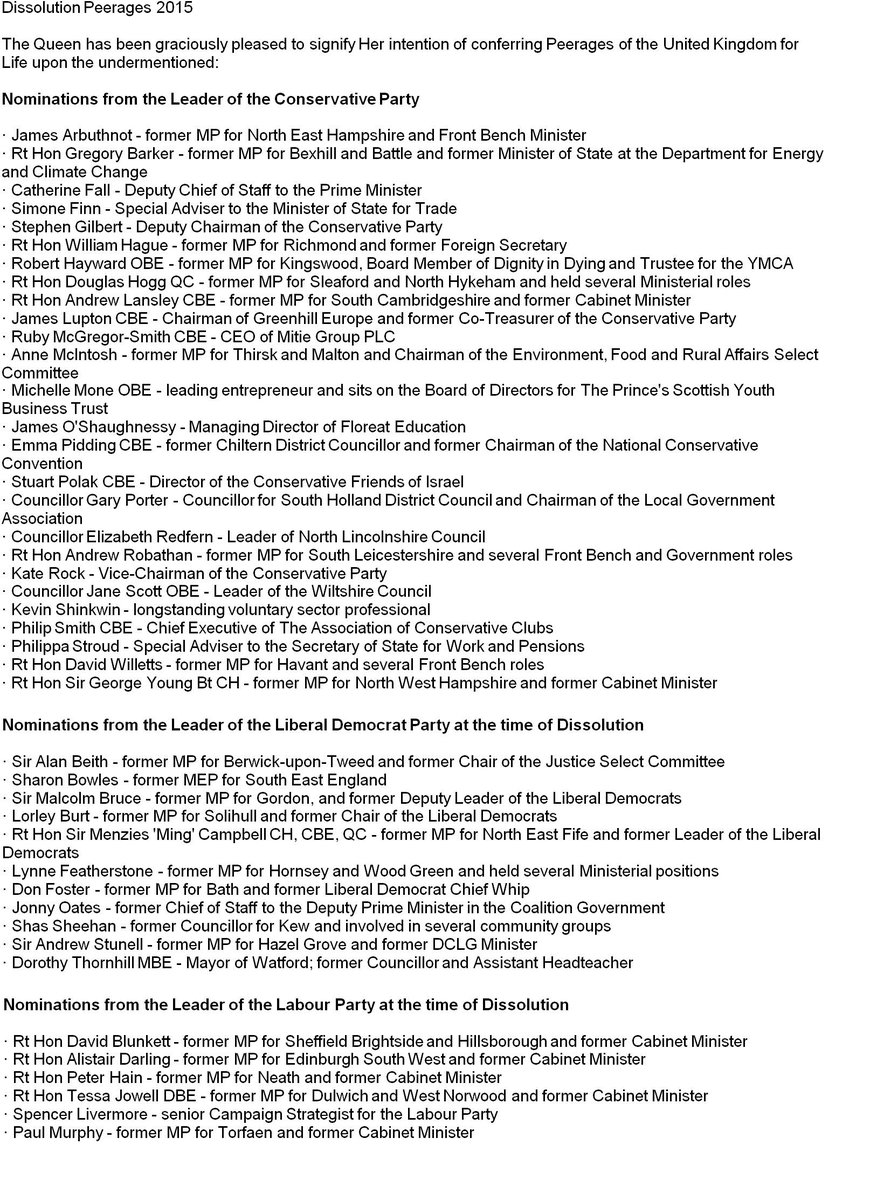
Subscribe to:
Comments (Atom)